About the project
Reading from the print
Since 2022 Arte Minima has been studying, performing and recording the complete motets of the Liber Primus Epigramatum — the first time this foundational print has been recorded in its entirety.
Method
No modern transcriptions. The ensemble works from the 1551 print itself, and extends that scrutiny to theory, instruments and tuning.
The sole surviving copy of the Liber Primus, held at the Bayerische Staatsbibliothek in Munich, demonstrates a meticulous printing process, with minimal errors and a clear alignment of text and music. The collection contains twenty-three motets, most of them settings of antiphons and responsories from the Office of Vespers. Their elaborate musical treatment — marked by considerable length and complexity — makes it unlikely that they were intended strictly for liturgical use.
They seem better suited to musica reservata, also known as musica secreta: an elite mid-sixteenth-century practice in Italy and southern Germany that emphasised emotionally expressive and refined text settings, typically performed by a small group of skilled musicians before an exclusive audience. The term «epigram» in the title further supports the idea that these pieces were designed for poetic and hermeneutic reflection, likely intended for private devotional settings.
Voices and recorders
The text underlay in the source is highly precise, but poses challenges for singers because of the length of the lines and the extensive melismas on the final syllables of words. One of Lusitano's melodic idiosyncrasies is the use of «melismatic tails» following the final note of a phrase, often beginning with clichéd motifs that recur across all voices and motets. Arte Minima reads this as a possible indication of a division between vocal and instrumental parts, marking the point where the singer might stop and the instrument continue. Other oddities in the underlay — musical segments without text, or the separation of letters within the same syllable — lend support to the hypothesis.
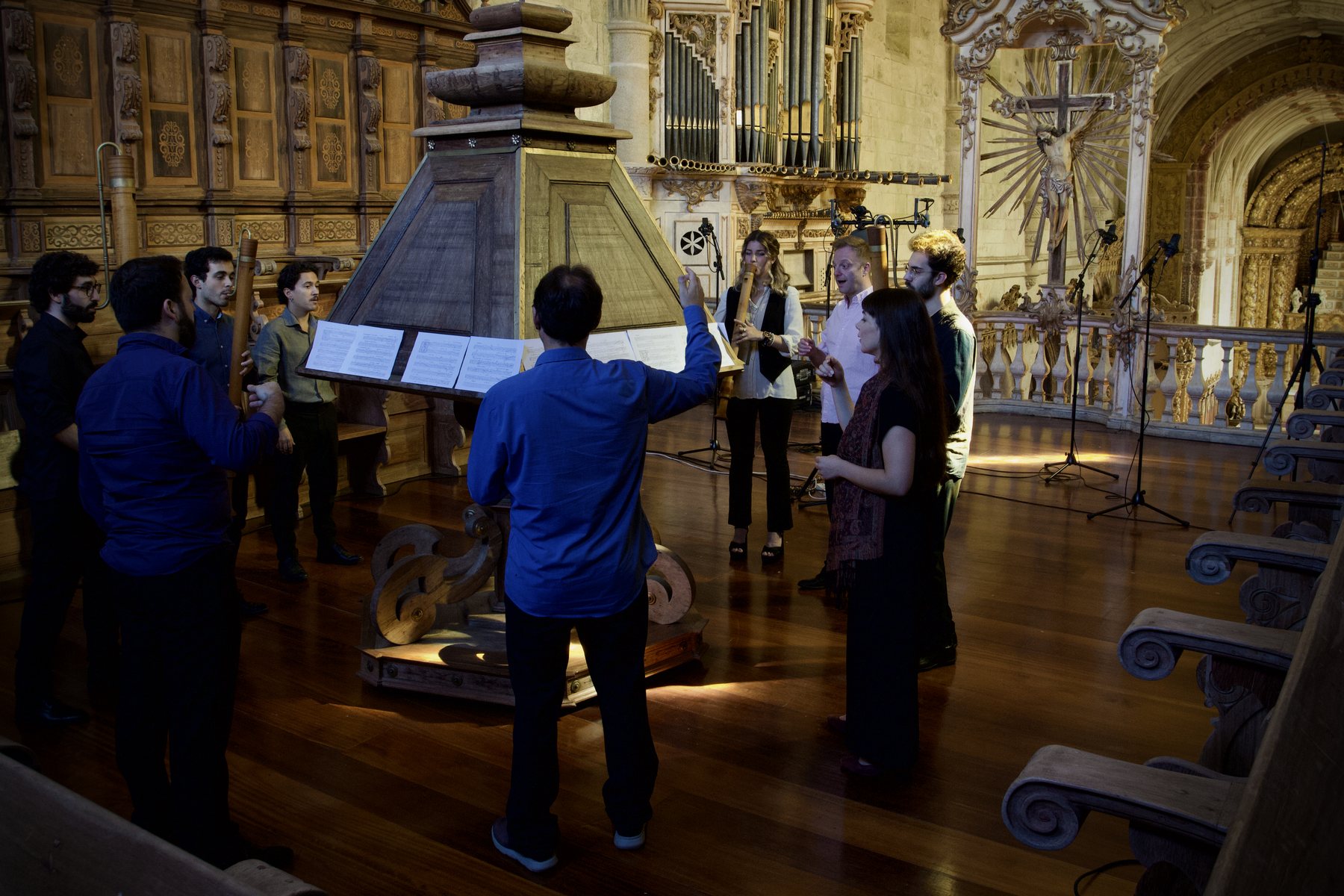
Soft instruments such as recorders or viols were not uncommon in the context of musica secreta, and Stevenson had already suggested that the density of Lusitano's inner voices might have an instrumental explanation. Here, recorders accompany the singers throughout: replicas by Adrian Brown and Bob Marvin after Gerolamo Salbrun and Bassano, Venetian instruments of the second half of the sixteenth century.
Another factor militating against the success of these motets was the difficulty of the inner voices, which, in such motets as Clamabat autem, Emendemus, and Preter rerum, seem to be instrumentally conceived.Robert Stevenson, 1962
A new reading
Manuel Pedro Ferreira, in a study as yet unpublished.
Who was Jerónimo?
Quid montes is the only setting of a secular text in the whole Liber Primus — in truth a Latin madrigal, whose narrative model is close to the publications of Cipriano de Rore or Adrian Willaert. Its text, in dactylic hexameters, invites the Muses to leave their harsh dwellings and settle in a new place, which plays host to a «Jerónimo» celebrated as the «great glory of our century».
Stevenson proposed that the name was a coded reference to Dom Dinis de Lencastre, dedicatee of the Liber Primus, through that of his late mother Jerónima de Noronha. The interpretation now advanced by Manuel Pedro Ferreira opens another avenue: the Jerónimo of the poem might be the young poet, painter and illuminator Jerónimo Corte-Real (c. 1526–1588), educated at the Lisbon court alongside Dom Dinis.
The hypothesis is reinforced by a numerical observation that emerged while preparing the recording. Each of the two sections of the motet contains 97 or 98 breves, depending on the voice. Taking as a reference the Portuguese alphabet of twenty-three letters codified by João de Barros in his Grammatica (1540), and applying gematria — current in polyphonic composition at least since Philippe de Vitry — the name Jerónimo yields 98 and Corte-Real yields 97. The name Lencastre likewise produces 97, suggesting that the motet pays homage at once to the young artist and to his hosts. The phrase curia maior, in the poem itself, resonates simultaneously with the papal curia, with Parnassus and with the surname Corte-Real.
Support
A Música Secreta de Vicente Lusitano is funded by DGArtes, Programa Caixa Cultura, Fundação GDA and Cultura Norte, with the support of ESMAE — P.Porto, CESEM-P.Porto, PORTIC, Património Cultural I.P. and Antena 2.
Funded by





With the support of