The composer
Vicente Lusitano
c. 1520 – c. 1561. Composer and theorist; author of the first anthology of music by a Portuguese composer printed abroad, and of the first music treatise by a Portuguese author printed abroad.
Olivença
A city then under Portuguese rule, with strong ties to Ceuta — Portuguese from 1415 to 1580 — to whose diocese Olivença was ecclesiastically subordinate between 1513 and 1570.
Much about Lusitano's life remains shrouded in mystery. The few details we have derive largely from seventeenth- and eighteenth-century sources, studied in more recent decades by Maria Augusta Barbosa (1977) and Robert Stevenson (1962, 1982). He was born in 1522 or earlier in Olivença, and must have studied music there under one Pero Brujel or Brugel, presumably a composer of Flemish origin — possibly the same «Bruxel» who appears in a sixteenth-century manuscript from the Mosteiro de Santa Cruz in Coimbra.
A seventeenth-century source refers to him as pardo. On that basis Robert Stevenson identified him as the first published composer known to have been of African descent.
Lusitano arrived in Rome on 3 January 1551, in the entourage of the new Portuguese papal ambassador, Afonso de Lencastre. The dedication of the Liber Primus suggests that he served as music teacher, or perhaps chapel master, to Afonso's son Dinis, who was twenty by 1551 and who appears to have been a significant supporter of his career.
Dinis's overwhelming greatness of soul and justly won reputation cannot be measured by the worth of the work herewith dedicated to him, but only by Lusitano's incomparable love and devotion.Liber primus dedication, translated by Stevenson, 1982
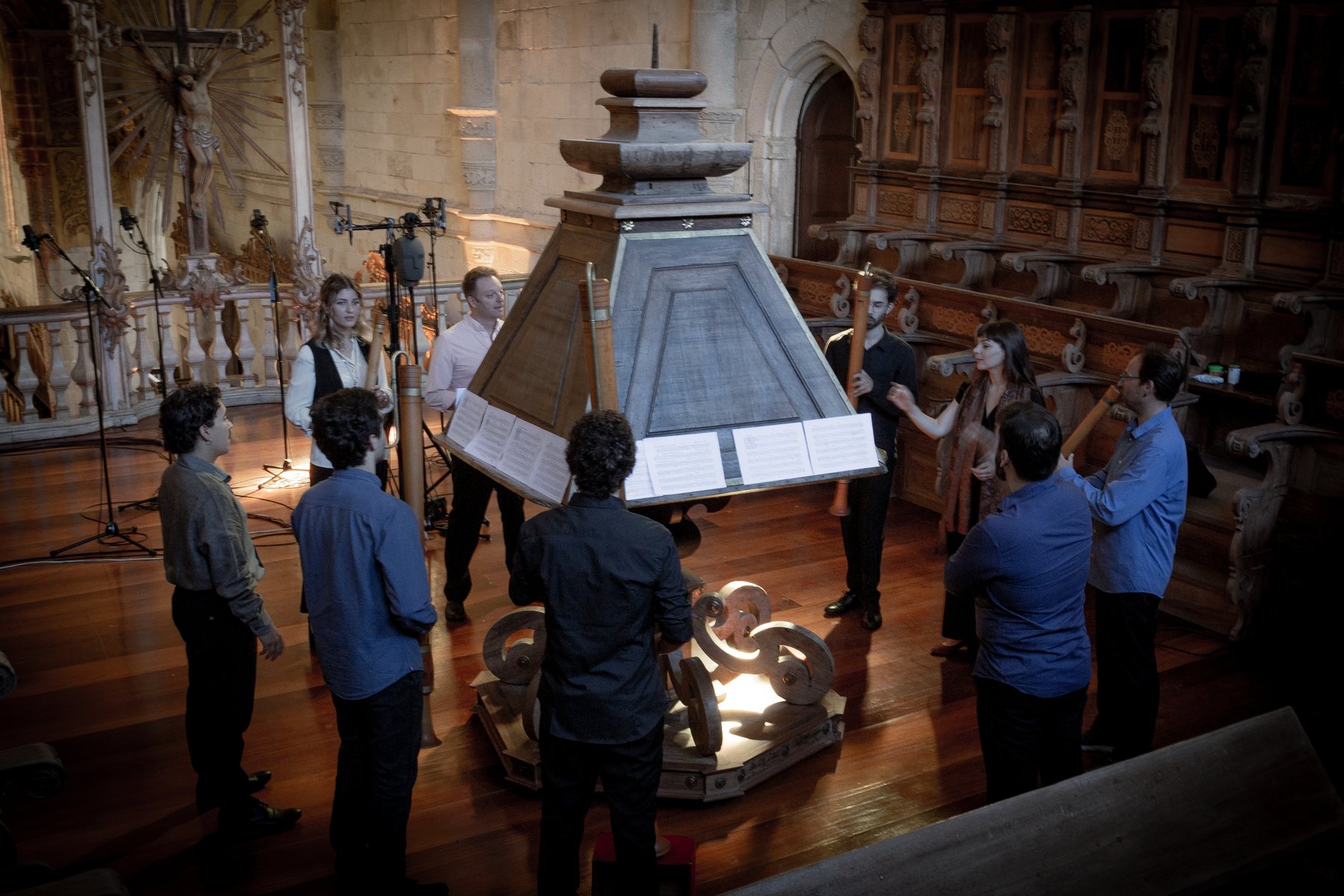
The debate
Rome, June 1551. The singers of the Papal Choir served as arbiters and awarded victory to Lusitano.
Theorist
Lusitano is still best known for his theoretical debate with the composer and theorist Nicola Vicentino, held in Rome in June 1551. It centred on contrasting perspectives regarding sixteenth-century interpretations of theoretical concepts from Greek antiquity, particularly concerning the tuning of specific musical intervals — a topic requiring such nuanced understanding that it borders on the limits of human perception. Perhaps as a result of that victory, Lusitano has long been regarded primarily as a music theorist; musicological studies over the past fifty years have largely concentrated on the content of his treatises rather than on his compositions.
His treatise Introduttione facilissima, et novissima, di canto fermo, figurato, contraponto semplice was first published in Rome in 1553, with subsequent editions in Venice (1558, 1561) and probably Lisbon (1603, now lost). It is the first music treatise by a Portuguese author published abroad.
After Rome
Lusitano seems to have enjoyed great success as a music teacher in Padua and Viterbo before converting to Protestantism in 1561, marrying, and travelling to Germany and France, perhaps in pursuit of better positions as a chapel master. The last indirect testimony of his work is the publication of a three-part madrigal, Allor che ignuda d'herb' et fior, included in the collection Il primo libro delle muse, a tre voci, printed by Girolamo Scotto in Venice in 1562. The text, in Petrarchan style, is anonymous; Lusitano's setting is perhaps a showcase of his engagement with the Italian madrigal tradition.
Two further works remain unrecorded by Arte Minima: the chromatic motet Heu me domine and the six-voice Beati omnes on the text of Psalm 127(128), offered to the Duke of Württemberg in 1561.